
Student Arrested for Changing Grades Over 90 Times.

​This past Thursday, a former student of Iowa University was in court on charges of hacking into his school grading system and professors and changing grades for himself and a few other students.

The FBI arrested — Trevor Graves, age 22 — in October, at Denver, his hometown. According to an FBI arrest warrant, the student planted hardware keyloggers on several school computers.

Hardware keylogger

Graves had help from other students. One would plant the keylogger, while the other would attend class and confirm a teacher had logged into his school account.

They would then retrieve the keylogger and extract the login credentials. University of Iowa did not implement two-factor authentication for its student management system, so the login credentials allowed Graves access to teachers' accounts.

This took place for a period of 21 months, between March 2015 to November 2016.

The act unfolded when a teacher noticed in mid-December 2016 that some of Graves' grades had changed without her knowledge. The professor informed the University's IT staff, who investigated and found the keyloggers. The FBI was called in to aid the investigation.

They found that Graves changed grades more than 90 times, for him and five classmates. They also found that he regularly stole exams and shared tests questions  with other students.

On December, 2016, the FBI and University of Iowa Police executed a search warrant at Graves' home, an off-campus apartment in Iowa City.

Investigators found keyloggers, phones, and thumb drives with compromising information. The phones contained records of past conversations between graves and his co-conspirators, while the thumb drives contained copies of stolen exams. Graves referred to the keyloggers using the term "pineapple."
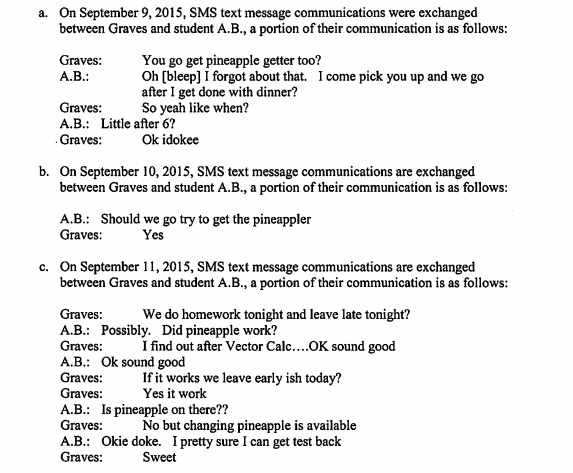
The FBI investigated and searched other students' houses, but only charged Graves.

Similar incident happened at Kansas University

In conversations with co-conspirators, Graves told them he could not change grades too significantly. Last spring, Kansas University expelled a student for a similar scheme. The unnamed student — not charged — used a similar hardware keylogger to steal teachers' login credentials and modify grades. That student changed F grades to A grades and was caught almost immediately, a reason why Graves' scheme lasted for 21 months.

Because the damage of Graves' actions was over a $5,000 limit (investigation into the hack cost $67,500), authorities filed charges against Graves. If found guilty, he'll probably face probation and hours of community work, as most cases like these have concluded in the past.

Graves was also a member of the University's wrestling team.

Comments

Popular posts from this blog

Floyd Mayweather Baby Mama Sues for $20 Mil ... He's a Despicable Liar

Floyd Mayweather could lose tens of millions of dollars from his big payday if his baby mama gets her way ... because she's just filed a lawsuit claiming he ruined her with lies to save his own ass. Josie Harris, who has 3 kids with Floyd, claims he lied through his teeth in an interview with Katie Couric just 2 weeks before the big fight ... when he claimed Josie was in a drug-fueled rage and he had to "restrain" her during their infamous 2010 domestic violence incident. Point of fact ... Floyd was convicted of domestic violence and spent two months in jail. Josie recounts her terror in the lawsuit, explaining how she and Floyd had broken up ... but he flew into a jealous rage that night, broke into her home and viciously attacked her while she was sleeping on her couch ... and her kids saw part of the beating. Harris says she is now labeled a drug addict thanks to Mayweather's lies -- and was embarrassed and humiliated on a global scale.   Her lawyer, Dan Friedl...

Google Authenticator, a formidable layer of protection to your account.

​Google Authenticator is a free security app that can protect your accounts against password theft. It's easy to set up and can be used in a process called two-factor authentication (2FA) offered on popular social media services like Gmail, Facebook, Twitter, Instagram, etc.  The app ( iOS / Android ) generates a random code used to verify your identity when you're logging into various services. The code can technically be sent to your phone via text message every time— but the Google Authenticator app provides an extra level of security.  SMS-based 2FA has a  known security flaw , and any devoted hacker can attempt to  socially engineer  an attack against your phone company. The Google Authenticator app eliminates the possibility of an SMS-based attack  using algorithms  to generate the codes on your phone. Here's how to set it up: 1. Download Google Authenticator from either the Apple App Store or the Android Google Play store. It's free. 2. Nex...

Are You Treating Your Kids Like Your Career?

And, we see this all the time. Hey,listen I've heard evidence of this phenomenon at the hairdresser, nail salon, at high school softball games, or at the grocery store. Mothers move in closer to each other and start to talk to one other very seriously and very competitively about their kids' achievements, successes, activities but certainly not about their disappointments, feelings, or emotional concerns. Nope, those topics are reserved for the night when those parents are alone with both the darkness of the night and their concerns. Now these are kids they are talking about, not careers. I'll tell you though that it sounds a whole lot like they are talking about jobs and job advancement. And, these kids who are their current careers, in my opinion, are at risk to become highly anxious and stressed as they struggle not to let their parents down. Don't kid yourself parents — your kids are desperately afraid of failing you. Want to figure out if your child has beco...